Steve McQueen and the Art of Driving Like You Mean It
He was a petrolhead who stumbled into Hollywood and never pretended otherwise. The story of Steve McQueen — and what he knew about presence and driving that most men never figure out.
MEN'S STYLEENGINESLIFE
A hot Saturday morning on Mulholland Drive.
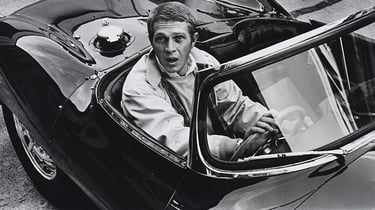
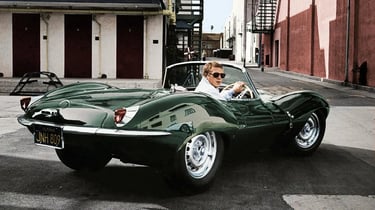
The road is quiet, but the ground is vibrating. A Jaguar XK-SS comes through at speed — 250 horsepower of British engineering being pushed hard through the curves of one of Los Angeles' most celebrated stretches of tarmac. The driver knows this road. He's brought his machines here before, and he always leaves having found out exactly what they are capable of.
There are men who drive to get somewhere, then there are men who drive because the driving is the point.
Steve McQueen was the second kind.
McQueen never hid the fact that he preferred engines to studios. Acting was how he paid for the machines. Racing was what he actually wanted to do — and his uneven filmography makes that clear enough. When a script excited him, he was extraordinary. When it didn't, he was somewhere else entirely, usually on a track.
The love of machines started early and by necessity. After a difficult childhood portrayed in his biography — a reformatory at fourteen, raised by his grandfather with no father in the picture — he enlisted in the United States Marine Corps, where he learned to work with his hands and discovered that engines made sense to him in a way that little else did. Mechanics was a language he understood instinctively.
Fame changed none of this. He didn't build the image of a man who loved machines. He was that man, and had been long before anyone knew his name. Long after he could have stopped, he kept showing up at races and events where nobody recognised him. Not for the attention but because he needed to be there.
That's the thing about a genuine obsession. It doesn't care about your reputation.
Catering to that passion, McQueen collected some of the most iconic machines ever built — not as a curator, but as a rider and driver who needed to use what he owned.
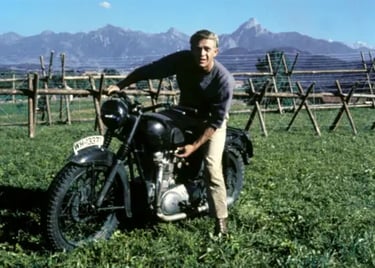
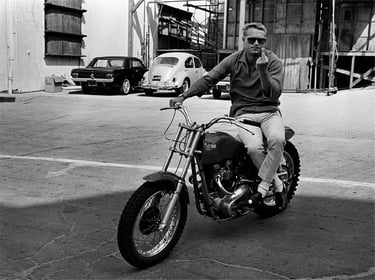
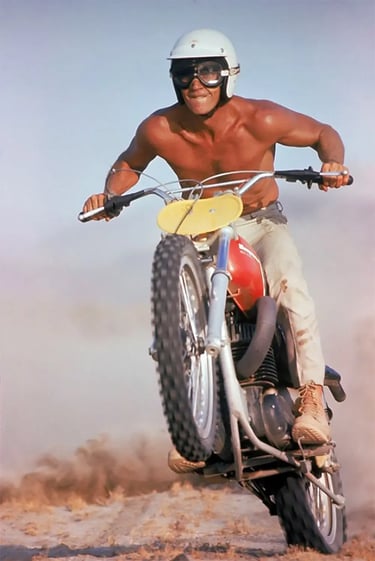
On two wheels, two machines defined him. The Triumph TR6, immortalised in The Great Escape, which McQueen rode himself in most scenes despite the studio's objections. And the Husqvarna 400 Cross, with which he competed in the 1964 International Six Days Trial representing the United States — not as a celebrity appearance, but as a genuine competitor against the best off-road riders in the world.
On four wheels, three cars tell the story.
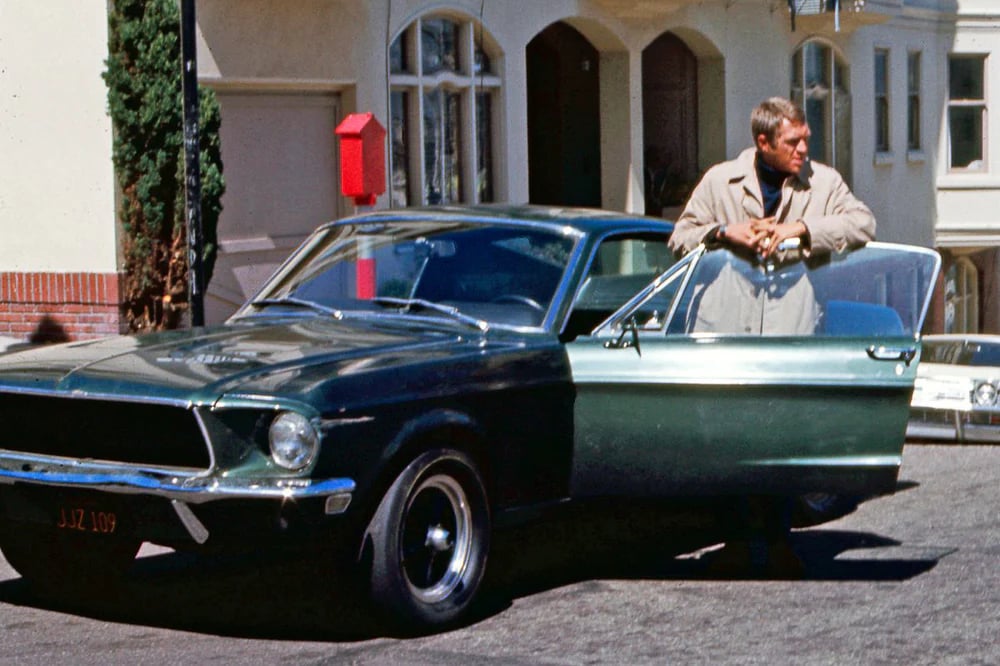
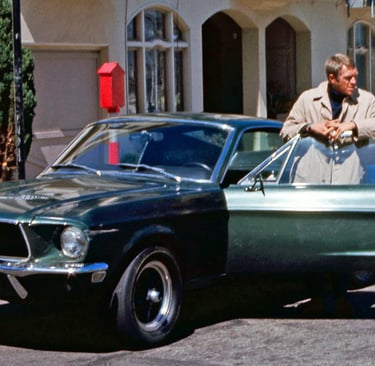
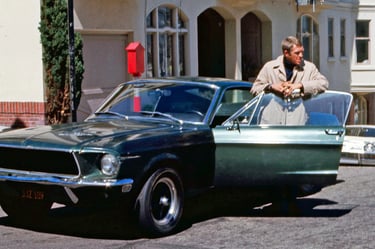
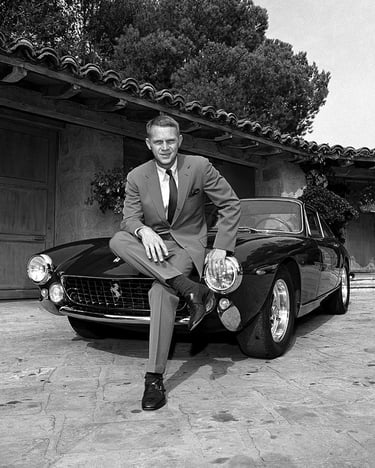
The Ford Mustang 390 GT — known simply as the Bullitt car — which he drove through the streets of San Francisco in the 1968 film that produced arguably the greatest car chase ever committed to film. The Ferrari 250 GT Lusso, which Jackie Kennedy personally asked him to keep safe after the assassination of JFK. That car sold at auction in 2007 for $7.3 million. And the Porsche 917, driven in Le Mans — the film he nearly died making, financed largely out of his own pocket, because no studio believed in it enough and he believed in it too much to let it go.
These weren't props. They were the point.
That is actually shown in his 1971 film Le Mans.
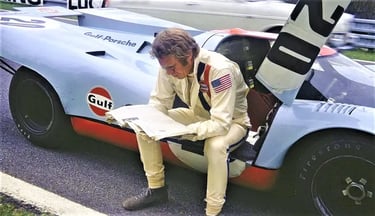
Le Mans is the film that captures him most honestly and the least understood of everything he made. It's not a film for cinema lovers. It's a film for petrolheads.
The studios hated the idea. A racing film with no conventional plot, no classic hero, no dramatic arc designed for mainstream audiences. Who would want to watch that? McQueen didn't care. The goal was never to make a blockbuster. The goal was to capture the 24 Hours of Le Mans as it actually was: dangerous, relentlessly long, simultaneously monotonous and electrifying. A film for people who understood what was happening on track, not for people who needed to be told why it mattered.
McQueen's idea was never really to make a film about Le Mans. He wanted to be at Le Mans. The film was the only available solution.
This tells you everything about how he understood machines.
For McQueen, cars and motorcycles were never simply transport. Speed was never simply speed. He understood instinctively and completely the concept of total presence. Physical, mental, and spiritual. The intention behind velocity. The particular state of mind that a machine moving at serious speed forces upon you, whether you're ready for it or not.
It's the same idea at the heart of Zen and the Art of Motorcycle Maintenance — which I wrote about here. On a motorcycle especially, beyond a certain speed, there is no room for division. The present moment is forced upon you as if your life depends on it.
Because it does.
"I'm not sure whether I'm an actor who races or a racer who acts." — Steve McQueen
This sentence sums up his entire position in life, perfectly stated. He was a driver. The acting career was what allowed him to keep driving.
That way of being, completely inside whatever he was doing, combined with a personal style that was entirely uncontrived, earned him the nickname the King of Cool. Not because he tried for it. Because he didn't.
The result was a look copied endlessly in pop culture and by the men who watched his films and wanted something of what he had. A few pieces became permanently associated with him. The Barbour jacket, worn on track, not at parties. The jeans, white t-shirt, and boots combination that required no thought because it was simply what he wore. The iconic TAG Heuer Monaco, worn in Le Mans, that's single-handedly responsible for a resurgence in the brand that continues today. And the sunglasses, the Persol 714, foldable, discreet, and so classically proportioned that they've never looked dated.
None of it was designed. All of it was earned.
Steve McQueen is one of the clearest examples I know of a man who lived with intention. Which is why he matters to this blog and why this article exists.
He was an icon of his time who became timeless. An actor who refused to be absorbed by the rotted world of Hollywood and its machinery, who used fame and money with a purpose: to do exactly what he loved. To collect and drive the finest motorcycles and cars of his era. To race when he could. To be present in a way that most people, famous or otherwise, never manage.
He died young, at fifty. He left behind an uneven filmography, a garage full of classics, and a way of being in the world that men are still looking for and copying today.
The King of Cool was never really about cool. It was about presence. About intention. About doing the thing you love with everything you have and not particularly caring what anyone else thinks about it.
Turns out that's enough to make a legend.
"I would rather wake up in the middle of nowhere than in any city on earth." — Steve McQueen
Subscribe to our newsletter
Be a part of the grit lifestyle