The Minimalist Workout — How the Fitness Industry Complicated Something the Greeks Already Knew
The fitness industry turned exercise into a complex system of programmes, supplements and optimisation. This essay explores a simpler approach inspired by the Greeks, calisthenics and minimalist training.
SPORTSLIFEBRAND STORY
7/3/20265 min read
There was a time when I was at the gym every morning at 7 a.m.
The sessions lasted about an hour. I liked the routine — the consistency of it, the way it structured the early part of the day before anything else could claim it. I was also training boxing daily at the time. Both, every day, without conflict. It worked because my life allowed it: no full-time job, no relationship, no house to maintain. The schedule had room for it.
That life no longer exists. And if I tried to recreate that routine today, neither would anything else.
What has not changed is the need for it. Exercise has always been an escape for me — not a punishment or an obligation, but a genuine release. The kind of thing that makes the rest of the day function better. Losing that was never an option. What had to change was the form it took.
What I have now is different. Shorter, simpler, and — for where I am in life — more effective than what came before.
About half an hour. No machines. No commute. No queues. No monthly fee.
Over the past few years I have become interested in fitness — particularly the less conventional approaches to it. And what I have noticed, consistently, is that the fitness industry has a tendency to sell everything at once, with no guarantee that any of it will work for you specifically.
What the industry has done, in effect, is take something humans have always done — move their bodies — and made it artificial. Complicated. Expensive. Supplements, highly specific nutrition plans, wearables measuring variables most people cannot interpret, long sessions divided between strength, hypertrophy, mobility, and cardio. All of it presented as necessary. All of it quickly becoming impossible to sustain for anyone with a life that extends beyond the gym.
This is not an attack on sports science. The progress made in that field over the past few decades is genuinely fascinating, and watching it applied to elite athletes produces results that would have seemed impossible a generation ago. That is real, and it matters.
But elite athletes live for training and through training. Their entire existence is structured around it — recovery, nutrition, sleep, everything in service of performance. A normal person has perhaps an hour a day, if that. Probably less. And applying the logic of elite sport to that hour produces not better results, but paralysis. The plan becomes too complex to follow consistently, so it is not followed at all.
This is where our ancestors had something right that we have largely forgotten. Not because they were wiser — but because they had no alternative. You moved because movement was necessary. You carried things, walked distances, climbed, lifted. The body was used as a body, without anyone telling you the correct protocol for doing so.
The results, by most accounts, were adequate.
The ancient Greeks understood something about the body that the modern fitness industry has spent considerable effort obscuring.
The gymnasium — from the Greek gymnos, meaning naked, which tells you something about their attitude towards the body and its training — was a central institution of classical Greek life. Not a commercial facility selling memberships, but a public space where citizens trained as a matter of civic duty and personal virtue. The training itself was straightforward: bodyweight movements, what we now call calisthenics, stones used as weights, wrestling, running. Several treatises from the period describe approaches to physical conditioning that are, by any honest assessment, more practical than most of what fills the pages of contemporary fitness publications.
The results were adequate. Greek sculpture is not documenting the exception.
The gladiators of Rome present a similar case. Men whose physical condition was, quite literally, a matter of survival trained on largely functional methods — calisthenics, iron and stone weights, conditioning work that included chopping wood and digging. No periodisation charts, no macronutrient tracking, no deload weeks. The training was simple because simplicity was available and complexity was not. And the physical results, documented in mosaics and historical accounts, were considerable.
Across every era, in every culture, the pattern holds. Simple movements, basic implements, the body used as a body. Not because people lacked the intelligence to develop something more sophisticated — but because sophistication was not required to produce a strong, functional, capable human being.
The human body has not changed significantly since then. What changed was the industry built around it.
The body does not need much. It never did.
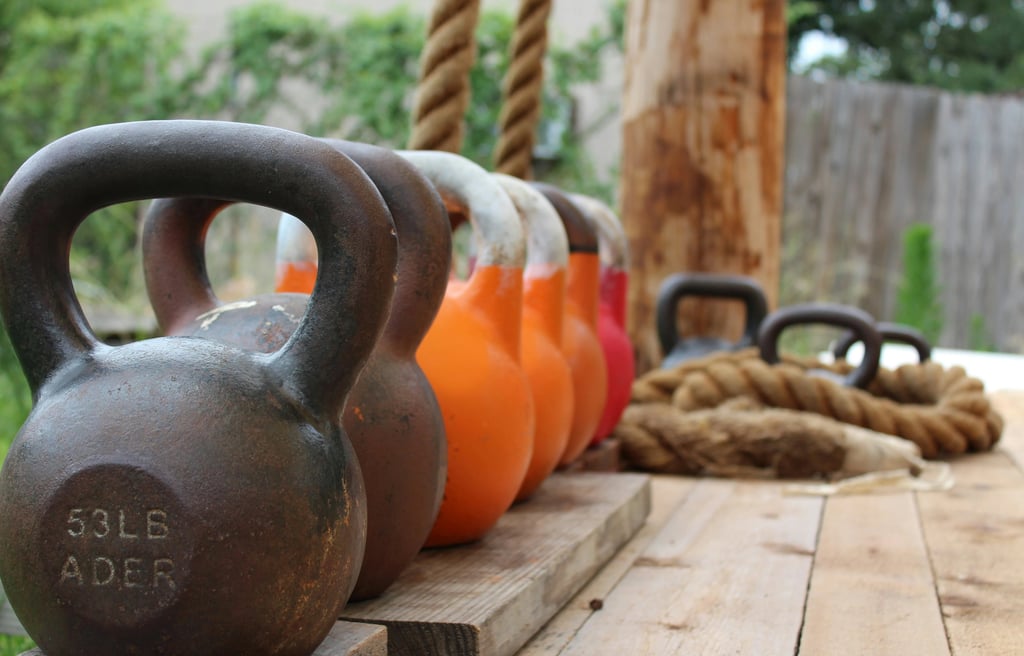
The training I do reflects that. Calisthenics and kettlebell work — accessible, simple, practical, and mostly compound movements. That last point matters: compound exercises work several muscle groups simultaneously, the way the body was designed to move, rather than isolating individual muscles in the way that bodybuilding-focused training tends to do. Functional movement rather than manufactured movement.
I do not follow a rigid programme. What I do instead is alternate, loosely, between sessions focused on the lower body, sessions focused on the upper body, and conditioning work — running, kettlebell swings, or anything else that gets the heart moving. The goal is to do something every day, even if that something is only thirty minutes.
A note before continuing: I have no formal training in this area, and I am not a competitive athlete. I am someone who likes to train, wants to feel well, and has found something that works for the life I actually have. Nothing here is professional advice — it is simply what works for me.
What I have noticed, though, is that people who want to start training often make the process so complicated that they give up before it has a chance to become a habit. They research the optimal programme, the correct split, the ideal rep range — and somewhere in all of that, the actual training never starts. Or it starts, becomes overwhelming, and stops.
The bar for beginning is lower than the industry wants you to believe.
Perhaps the problem is not that we know too little about fitness, but that we know too much.
Or at least, we have access to more information than we can realistically use. Every week there is a new protocol, a new study, a new optimisation strategy promising better results in less time. The assumption behind all of it is that the body is infinitely improvable if only we apply enough data to it.
For most people, that assumption is irrelevant.
Most of us are not preparing for competition. We are not trying to shave seconds off a race time or maximise every variable of physical performance. We simply want to remain capable. To feel strong enough to carry our own weight through life. To have energy, resilience, and the quiet confidence that comes from knowing the body still functions as it should.
That does not require perfection.
It requires consistency.
A few basic movements, performed regularly, over months and years, will always outperform an elaborate programme abandoned after three weeks. The body responds remarkably well to being used. It always has.
The Greeks understood this. So did countless generations before and after them. Movement was not a hobby, an identity, or a subscription service. It was simply part of being human.
Perhaps the most effective workout is not the one designed by an algorithm, a fitness influencer, or a sports scientist working with elite athletes. Perhaps it is simply the one you can continue doing when work becomes demanding, when responsibilities accumulate, and when life inevitably becomes more complicated.
Thirty minutes. A kettlebell. A run. A few pull-ups. Some push-ups.
Nothing revolutionary.
Only a reminder that strength was never meant to be complicated.