Nobody Photographs the Ordinary. That's Exactly Why I Do It.
The images that fascinate us most today are the ones that show how ordinary life looked before we were alive — not the great moments, but the mundane ones. Street photography is the practice of paying attention to what everyone else ignores. A Coimbra flea market, a vintage camera, and the argument for documenting the world before it disappears.
BRAND STORYLIFE
6/12/20263 min read
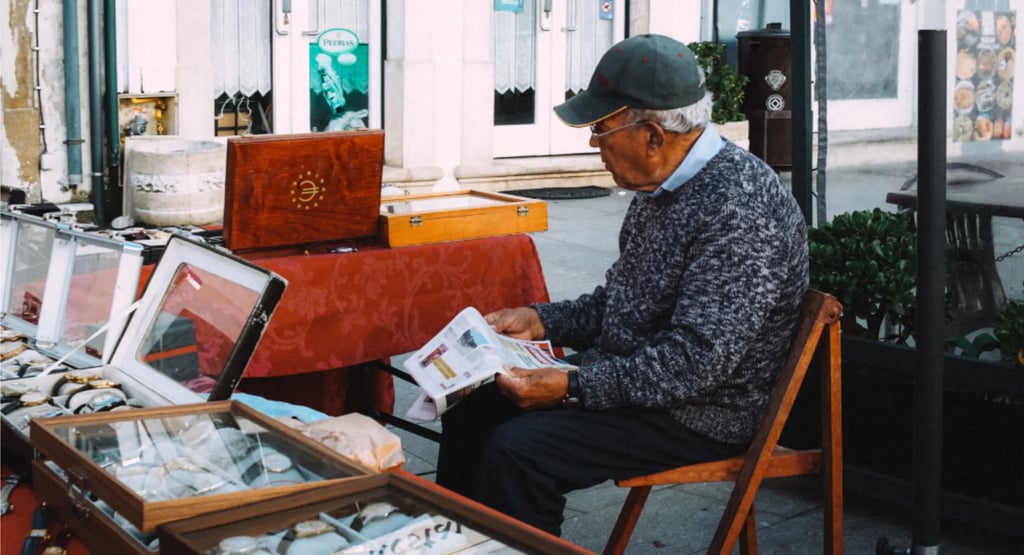
A flea market in Coimbra is a fairly ordinary sight. There are several throughout the year. Hundreds of people moving between stalls, selling old things, looking for something worth finding at a price that makes the search worthwhile. I often bring my camera.
This time I stop in front of a stall covered in old watches. Behind it, an elderly man is reading his newspaper. He seems more interested in it than in anything happening around him, including his own sales.
I decide to photograph him. Not because the scene is extraordinary. Not because it takes my breath away. But because it is a piece of what is normal today and what might be history a hundred years from now. The street market. The analog watch faces. The printed newspaper. The man himself. None of these things are guaranteed to exist in a century. Neither is that man. Neither am I. But the photograph will be there to tell the story.
The images that fascinate us most today are the ones that show how ordinary life looked before we were alive. Not the great moments but the mundane ones. A busy Lisbon street in the 1940s. The University of Coimbra in the 1960s. Street vendors in 1950s London. The photographers who took those images were simply documenting what surrounded them. What seemed unremarkable at the time became, with the passage of years, an important piece of history.
It is always the tourists who walk around with cameras. And they photograph what is new to them — the monuments, the events, the special moments. There is nothing wrong with that. But what gets left behind is everything else. The people, the habits, the texture of daily life that is particular to each city, each country, each era. That is what disappears without anyone noticing — because nobody thought to photograph it.
This is what draws me to street photography. Capturing the moments that seem mundane today, the ones that, in fifty or a hundred years, will allow someone to understand what ordinary life actually looked like right now. Like opening a history book. The same way we look at photographs of everyday life from the early twentieth century and find in them something that no monument or official record quite captures.
It is the simple, ordinary moments that disappear into history. The extraordinary speaks for itself. The street scenes that reflect the mundane do not.
Street photography sits apart from what social media has made of the image. Not because street photographers aren't on those platforms, we are. But because the work itself resists the logic of what those platforms reward. There is no studio here, no perfect light, no complex post-processing. There are limitations, technical ones, circumstantial ones, human ones.
Most street photographers work with a single lens. Often a compact, unassuming camera. Mine is a Sony a6000. Old by current standards, but it does exactly what I need it to do. I chose it for being light and for attracting little attention. For lenses, I prefer vintage manual focus glass. Old, excellent quality, and remarkably affordable compared to modern autofocus alternatives. This goes back to where I started, in 2020, with a Pentax K1000 and a 50mm manual lens. Around €130 for the whole setup. That is what I learned everything on. Roll after roll of film, just practising.
The technical limitations are not a problem to solve. They are the point. They create a state of constant attention to what surrounds you. You are not in a controlled environment. You are looking for real moments, the ones that can be captured and kept. The photographs are imperfect. But they tell a story. And that is precisely what they are for.
The extraordinary takes care of itself. The festival, the monument, the landmark, these things announce themselves. The street does not. The ordinary moment camouflages itself into the everyday, and only gains its full weight when someone decides to pay attention to it.
That is what I am doing when I bring the camera.